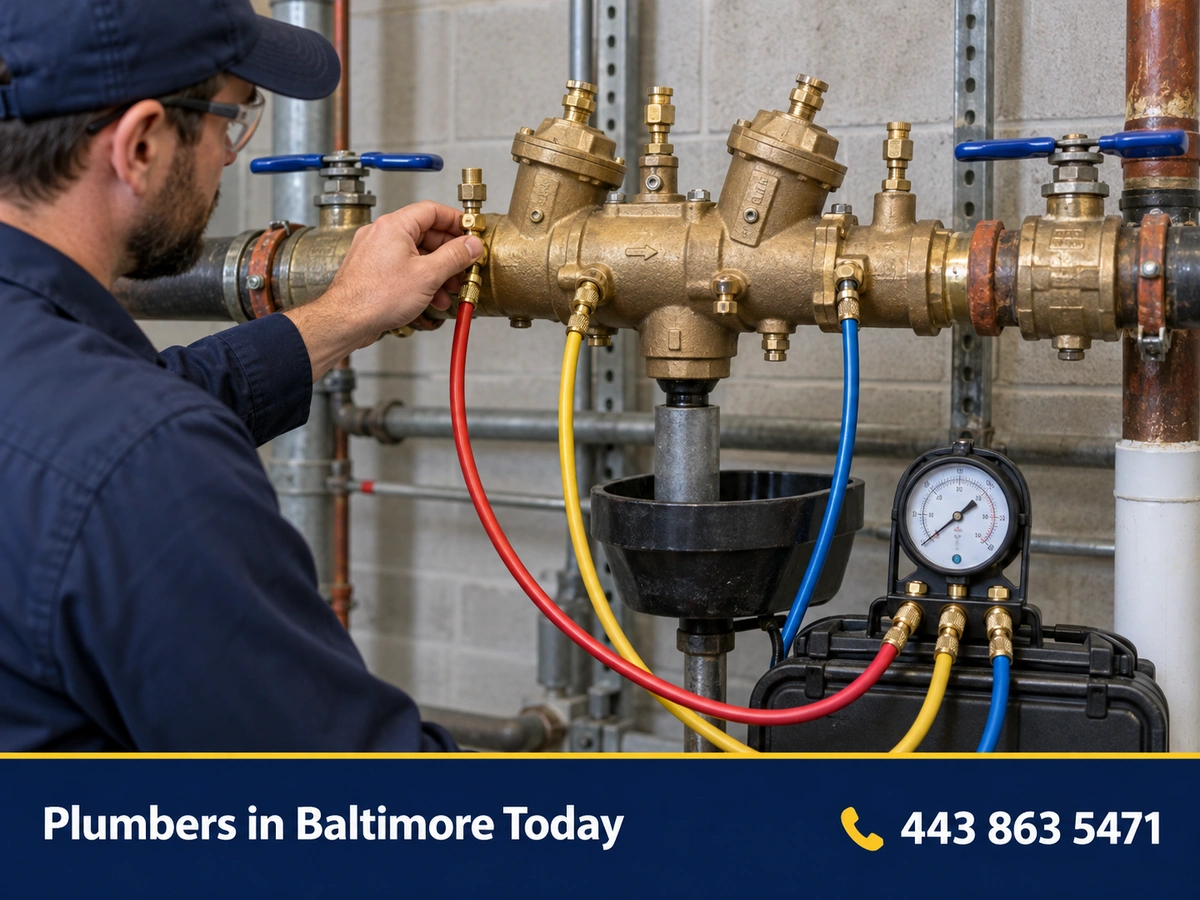
Water lines & fixtures
Backflow preventers stop contaminated water from being pulled back into the public water supply. Testable assemblies are generally tested when installed, after any repair, and at least once a year, and in Maryland the tester must hold a journey or master plumber license and have completed a state-approved backflow testing course. The tester files the results with your water utility, which sets your deadline.
Who needs backflow testing
- Restaurants, coffee shops and commercial kitchens
- Medical and dental offices, labs and car washes
- Laundromats, salons and manufacturing sites
- Buildings with fire sprinkler systems or chemically treated boilers
- Apartment and condo buildings with booster pumps
- Homes and businesses with lawn irrigation systems
If your water utility has sent a test notice, you have a testable assembly on file.
Types of backflow preventers
- Reduced pressure zone (RPZ) assembly: for high-hazard connections such as medical, chemical and some commercial kitchen equipment
- Double check valve assembly: for lower-hazard connections, such as many fire sprinkler lines
- Pressure vacuum breaker: common on lawn irrigation systems
Annual testing and reporting
Your water utility tracks each assembly and sends a reminder when a test is due. The tester checks each valve with a calibrated gauge kit, makes any repairs, and submits the report to the utility. Requirements and deadlines vary by utility: Baltimore City DPW serves the city and much of Baltimore County, Anne Arundel and Howard counties run their own systems, and WSSC Water, which serves the City of Laurel, takes reports through its online cross-connection system. Follow the deadline on your notice.
In Maryland, a backflow tester must hold a journey or master plumber license and a certificate from a Board-approved 32-hour backflow testing course. You can check a plumber's license with the Maryland State Board of Plumbing.
When an assembly fails
Common causes are debris on a check valve, worn rubber seats and seals, or a relief valve that won't close. Most failed assemblies are repaired with a parts kit on the same visit and retested; badly corroded or obsolete assemblies are replaced. An RPZ that drips or dumps water steadily from its relief port is telling you a check valve isn't sealing, so call for repair rather than waiting for the annual test.
Installing a new backflow preventer
New irrigation systems, fire sprinkler connections, boiler feeds and commercial build-outs usually need an approved backflow preventer, a permit and an initial test. RPZ assemblies are installed above ground where they can be reached for testing, with a drain to carry away relief discharge.
How to get backflow testing and prevention in Baltimore
- Call 443-863-5471. Tell us what's happening and where you are. Calls are answered 24/7.
- We connect you. You're put through to a licensed, independent local plumber who handles this kind of job in your area.
- Get a clear quote. The plumber explains the problem and the price before any work starts.
- You decide. Approve the work, and the plumber completes it with any permit your city or county requires.
Plumbers in Baltimore Today is a free referral service; we don't perform plumbing work ourselves. How it works.
Frequently asked questions
How often does a backflow preventer need testing?
At least once a year in most cases, plus after installation or any repair. Your water utility's notice gives your deadline.
Do homeowners need backflow testing?
Usually only if the home has a testable assembly, most often on a lawn irrigation system or a residential fire sprinkler line. If your utility sends a notice, a test is required.
Who can test a backflow preventer in Maryland?
A journey or master plumber who has completed a Board-approved 32-hour backflow testing course and holds the certificate.
My RPZ is leaking water. Is that an emergency?
A steady discharge means a check valve isn't sealing. It isn't usually dangerous, but it wastes water and can flood the area, so get it repaired promptly.